The National 2½" Gauge Association
|
The National 2½" Gauge Association |
|
| Keeping the spirit of the past alive for tomorrow and looking to the future | ||
| The National 2½" Gauge Association is a not-for-profit organisation | ||
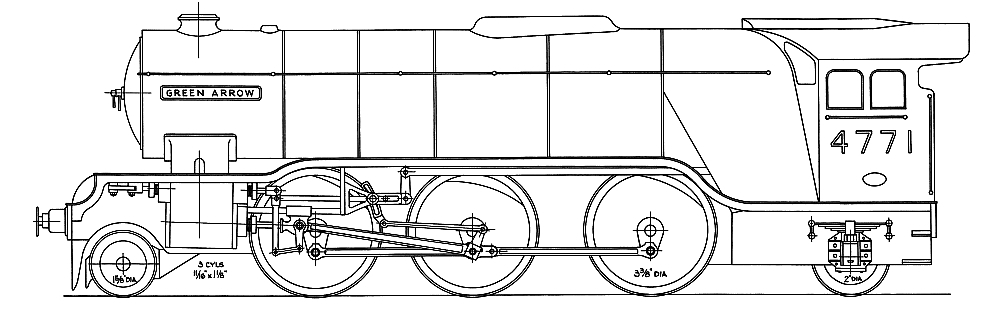
Sheet 1 - Locomotive GA and Main Frames
Sheet 2 - Wheels, Axles, Pony Truck, Coupling Rods, Axle Pumps
Sheet 3 - Cylinder Details, Connecting Rods, Motion Brackets
Sheet 4 - Valve Gear
Sheet 5 - Boiler, Smokebox, Lubricator
Sheet 6 - Regulator, Boiler Fittings, Grate, Ash Pan, Pipework
Sheet 7 - Tender
Coupled & Driving Wheels
Bogie and Trailing Truck Wheels
Tender Wheels
Slide Valve Cylinder Sets
Inside cylinder block
Eccentric straps, pump bodies, etc.
Note : most castings (incl. inside cylinder) are available from the Association.
ALTHOUGH the full-sized "Green Arrow" on the L.N.E.R. has the distinction of being the first "Prairie" type tender engine to be placed in regular service on any British railway, she has been anticipated in the small locomotive world, for some years ago Mr. Fogg, of Manchester, took the "works" of a L.N.E.R. 2½-in. gauge 2-6-0, added a trailing truck and a larger boiler, and produced a speedy and efficient little engine remarkably like the "Green Arrow" in personal appearance. A Coventry reader also built a big-wheeled 2-6-2 tender engine of Southern "flavour," which was also very fast and powerful. Both these engines had, however, only two cylinders; but it does not alter the fact that once again builders of miniature locomotives not only anticipated what was coming in full-sized practice, but actually produced the "samples in advance" !
Well, "big sister" has taken the road, and as some of the readers of this journal have expressed a wish to copy her in the small size, we will proceed to describe a small edition, and kick-off with a preliminary survey. As mentioned before, the great trouble in building a little engine to look like its big relation, and yet be an efficient worker &emdash; very important that &emdash; is that nature cannot be "scaled," and if you made all parts of the little machine in strict, proportion to the big one, she would not be able to stand up to hard work for the proverbial five minutes. Again, you cannot arrange the parts of the little engine in precisely the same way as the big one, and must compromise if the job is to be a practical proposition, as I will explain as we go along. I'm just mentioning this now to prevent a great deal of unnecessary correspondence on the subject of "why was this or that altered?" Another thing is the cost of the job, which is a very serious item with the majority of the good folk who build little locomotives for a hobby. If special patterns are needed, up goes the price of the castings and parts at once, and if the builder has to make his own patterns, the job hangs out for yews and he loses interest in it before the wheels go around under their own power. Bearing these facts in mind, I have schemed out the whole bag of tricks in a manner which will, I hope, remove all difficulties.
In making the outline drawing of the engine, I found out what stock sizes of wheel castings supplied by our advertisers, came nearest to the correct proportionate size for 2½-in gauge, and set them out at the proper wheel spacings for the full-sized engine; then the rest of the outline of the locomotive was added to the same "scale," with the correct appearance you see in the reproduced illustration. This has permitted the use of stock cylinder castings for {she outside cylinders, and stock pattern castings for trailing and tender springs and axle boxes. In fact, the only special casting needed for the whole outfit will be the inside cylinder, which must have an offset steam chest in order to operate with the Gresley gear, as per "big sister". If I can possibly find time, I hope to make a pattern for this cylinder myself, so that suitable castings will be available.
The constructional series appeared in English Mechanics between 4th December, 1936 and 20th August, 1937.
TEE Publishing can supply a reproduction booklet of the constructional series.
This page was last updated on 10/12/2017